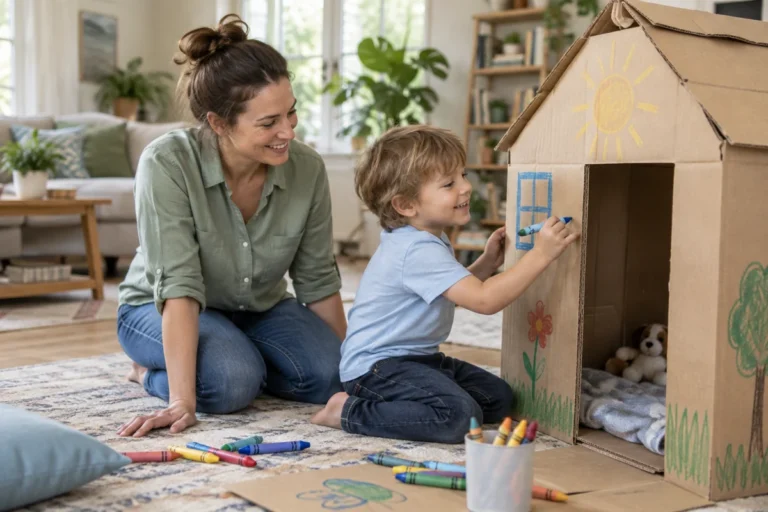


After a day with plenty of people, places or instructions, another organised activity may be the last thing anyone wants. A familiar book, a few building pieces or a small pretend scene can offer somewhere gentle to begin at home. The invitation does not need to fill the evening or produce a result. Notice the ordinary needs already in front of you, make a little room and offer one manageable choice. Your child may take it up, change it or prefer something else, and you can respond within the time you have.
Look at the real shape of the afternoon
Think about what needs to happen next: a meal, a rest, an appointment or simply arriving home. Those practical needs matter more than fitting in an extra play idea. If you have a short window, choose materials that are easy to bring out and put away. A complicated craft that needs close help may be a better fit for another time. You are choosing an invitation for this particular day, not deciding what your family should enjoy every afternoon.
Reach for something familiar
A known activity can make the first step clear without a long explanation. You might place a favourite book where you can sit together or offer a small suitable selection of blocks. Keep the materials appropriate to the child and their instructions. There is no need to introduce a new toy to make the moment special. Familiarity also helps you judge the preparation involved, so the invitation stays within the energy and attention you can comfortably offer.
Offer one possibility in ordinary language
You could say, ‘The blocks are here if you would like to make something,’ or ‘I can read this with you for a little while.’ Keep the invitation simple and avoid promising that it will change how anyone feels. Your child may want you to join, may prefer another activity or may not be ready to begin. If you need to do another task, be clear about what help is available rather than setting out materials that require you to stay and then leaving unexpectedly.
Let the activity be smaller than usual
A few pages, one little tower or a short pretend meal can be enough. There is no requirement to complete the whole game, use every piece or finish a picture before the time counts as play. If your child wants to repeat one action, allow that where it is appropriate. You can stay interested without continually suggesting what should happen next. A modest invitation leaves room for the day to settle into its own pace instead of adding another sequence to follow.
Keep the next transition in view
If dinner or another task is approaching, give a clear, gentle indication of when the activity will pause. Where possible, choose a stopping point together. An unfinished creation may be able to wait in a suitable place, or you may need to gather it for another day. Avoid promising unlimited time when you know the room or your attention will soon be needed. A small honest boundary makes the invitation easier to support and the ending less surprising.
Notice preferences without turning them into rules
Over time, you may see that a book, a little drawing or simply being alongside you is often welcomed after a busy day. Keep those observations as useful possibilities, not a fixed routine that must work every time. People and days vary. If the invitation is repeatedly awkward, simplify it or leave it out. The point is to make an ordinary moment easier to enter together, with enough room for what your family actually needs when you get home.