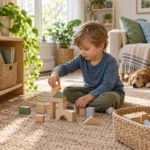
Start with one usable floor area, a small selection of suitable items and a clear place to put them away. A play corner does not need a dedicated room or a shopping list of new toys. The purpose of this planning approach is to make everyday play easier to begin and easier to tidy, using the space your household already has.
Choose the place before choosing products
Walk through your normal day and identify a spot where play will not block a doorway or a frequently used route. Think about where an adult can be present and where the items will go when the room is needed for something else. A corner that looks attractive in a photograph may still be inconvenient in your own home.
Sketch the available floor area and storage rather than buying furniture immediately. Include the space taken up when a basket is open or a toy is spread out. Follow furniture installation instructions, including any required anchoring, and keep items that are unsuitable for the child out of reach. An illustration is an idea for arrangement, not a safety assessment of your room.
Offer a few different ways to engage
You might begin with a book, an age-appropriate matching activity and something for building. These are examples of activity formats, not a required developmental programme. Choose from what you already own and what your child can use according to the product instructions. A familiar item may be more useful than a new one that is difficult to introduce.
Put out a manageable selection and keep the rest stored. If an activity has many pieces, check whether the manufacturer allows using a subset and whether every piece remains suitable. Do not mix in small accessories from an older child’s collection. The aim is a simple starting point, not a challenge to display the largest possible collection.
Make storage part of the plan
Give each activity a predictable home. That might be a basket for one complete set and a low, accessible place for books. Try the arrangement yourself: can you collect everything without moving several other objects first? If putting things away requires a long sorting session, simplify the selection before adding more containers.
You can describe the tidy-up sequence in a few ordinary words: books here, this set in its container, then the floor is clear. There is no need to turn the sequence into a performance target. Allow for unfinished projects when the space permits, and decide where they can wait without becoming an obstacle.
Observe what needs changing
After several ordinary uses, notice which practical details cause friction. Perhaps the container is awkward to open, the activity needs a larger surface, or the collection has too many loose pieces for the time available. Change one thing at a time so you can tell whether the adjustment actually helps your household.
Avoid treating a child’s interest in a particular activity as a score for the room or a reason to make learning claims about a product. Preferences and circumstances vary. This guide is an organising framework; it does not assess development or replace advice about individual needs.
Buy only for a clear gap
If you identify a missing activity, compare the format and storage requirements before the marketing claims. Our shape-sorter and building-block comparison illustrates that decision with two documented products. Check the current product listing, age label and instructions separately. A deliberate choice that fits the room is more useful than a shelf filled just to match someone else’s setup.