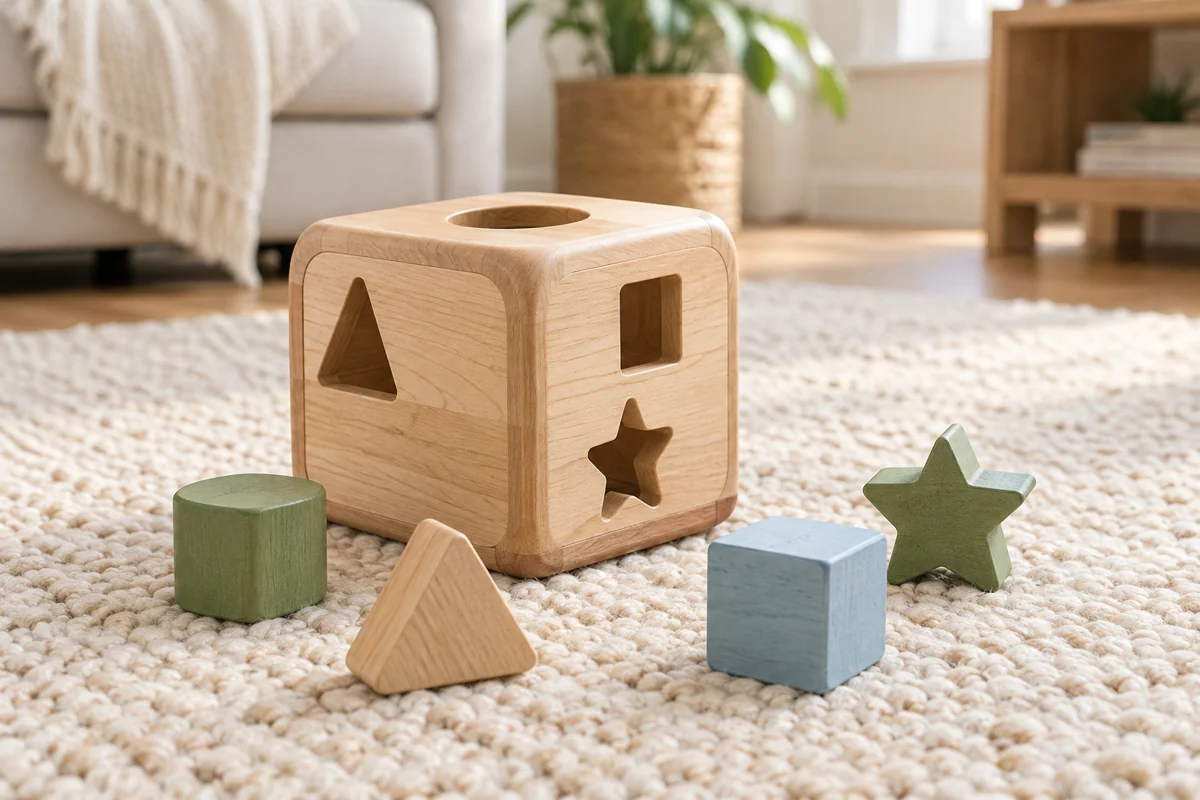
A child gathers all the blue pieces, then suddenly puts one red piece in the middle. It is tempting to ask whether that one belongs. But perhaps it is a visitor, a favourite or simply the piece they wanted next. A sorting activity can leave room for choices that do not match the adult’s original plan. You can notice colours, shapes and groups without making every action a question with one correct answer. Start with suitable materials and a little space to see what your child finds interesting.
Offer a manageable selection
Choose an age-appropriate set and follow its instructions, especially when it includes small pieces. Set out only a workable selection if the activity allows it, keeping the remaining materials together. Too many pieces can make the invitation harder to see and the pack-away longer. A small group gives you a chance to notice the action your child chooses: lining up, placing in containers, matching or making a pretend scene. Those different starting points do not need to be corrected into one intended task.
Describe something before asking something
Instead of immediately asking for a colour name, you might say, ‘You have put those two together,’ or ‘That one has a curved edge.’ Keep the observation simple and leave a pause. Your child may add a reason, show another piece or continue quietly. You do not need a response to make the comment useful as shared attention. A stream of questions can turn an ordinary activity into a performance, even when each question seems friendly on its own.
Invite a match when the interest is there
If your child is clearly looking for matching pieces, you can offer help or place two options nearby. Let them try at their own pace, within the product’s intended use. If a piece does not fit, you might notice what happened and ask whether they would like another idea. Avoid taking over every difficult moment just to complete the set. A short attempt, a little help or a decision to choose another action can all be reasonable ways for the session to move on.
Allow the groupings to change
A child may sort by colour at first, then by a feature you had not noticed. They may also abandon sorting altogether and decide the pieces are guests at a party. If the materials can be used appropriately that way, you can follow the story. The activity does not lose its value because it stops resembling the picture on the box. You can keep an adult-led matching game for another moment when both of you want that clearer structure.
Use the printed activity as an option
Cards or instructions can provide a helpful starting point, particularly when nobody knows what to do first. Read the product guidance and choose an appropriate activity, then introduce it simply. There is no need to work through every card in one sitting or treat the collection as a progress chart. If the format calls for a specific game, explain that clearly; if you are offering free exploration, leave room for it to be genuinely open. Knowing which invitation you are making can prevent unnecessary corrections.
Finish by gathering, not assessing
When the activity ends, help the pieces return to their storage place. You can mention a detail you enjoyed noticing together without reviewing how many matches were right. Perhaps your child made a long line or invented a reason for the red visitor. Those are things you can remember without turning them into scores. A simple sorting set can be part of a relaxed play corner, with enough structure to begin and enough room for the child who is actually using it.