The short version
A little help with your decision
A sensible shortlist option when you want one clear matching activity. The twelve shapes offer a specific puzzle to return to; they do not replace the freedom of a building set. Choose for that difference, rather than a promise of faster learning.
A good fit if…
Your child meets the stated age guidance and enjoys trying pieces in different spaces. You would like a contained activity to sit beside and explore together.
Look elsewhere if…
You want to build different things, need a toy for a child below the stated age range, or already have a shape sorter your child enjoys.
Some play moments begin with a big idea. Others begin with a child turning one small piece over in their hands. If that second kind of play sounds familiar, a shape sorter can be a lovely activity to make room for. The question is whether your child wants a matching puzzle, and whether you have space for another one.
What you’re actually choosing
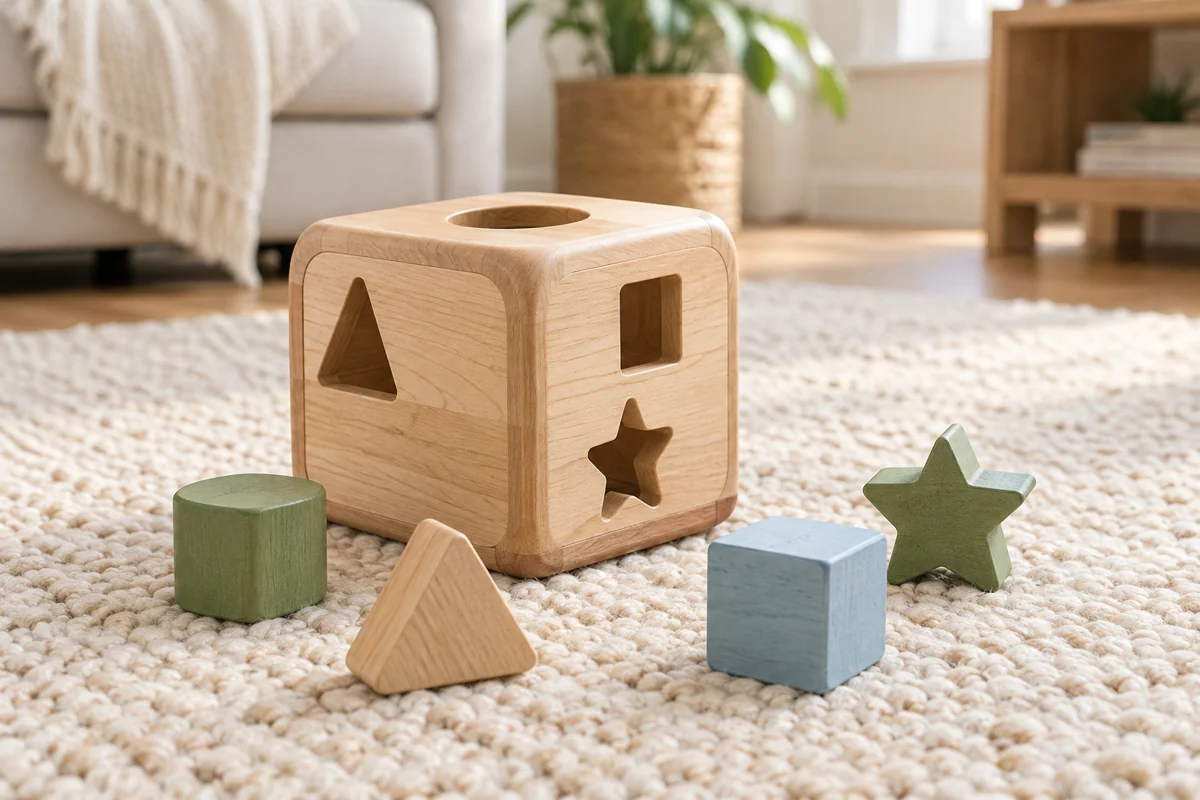
The linked Melissa & Doug Shape Sorting Cube is a wooden cube with twelve shapes. The Amazon US listing states ages two and up. Those details identify the option discussed here; follow the guidance on the exact item you buy.
Think of this as a focused puzzle. There is a particular opening for a piece, so the invitation is to look, turn and try. That can feel reassuringly simple on a busy afternoon. It also means there are fewer ways to change the main activity than with a pile of building blocks.
Make the first few minutes easy
You do not need to put every shape in front of your child at once. Try a small selection and sit nearby. If they pause, you can point out one opening or turn the cube a little, then leave room for their next attempt. There is no need to name every colour or turn the moment into a quiz.
A few tries can be enough. If your child starts carrying the pieces somewhere else, loses interest or wants you to join in, that gives you useful information about the kind of play they want today. Put the set away and come back another time if that suits your day.
The everyday trade-off: a clear task, with pieces to collect
A cube gives the toy a recognisable home on a shelf, but the shapes can still end up under a chair. Before buying, imagine your usual tidy-up. Would it be easy to collect the pieces together? Could you keep the whole activity in one reachable spot? A simple place to put it may matter more than another feature on a box.
There is also no reason to replace a sorter that already works for your family. A new material or shape count is not automatically a better everyday experience. If you already have a similar toy, try presenting fewer pieces or moving the play spot first.
Would building blocks suit your child better?
If your child mostly wants to make towers, change their mind and start again, take a look at the MEGA BLOKS building bag. It offers a different kind of invitation. Our sorting-versus-building comparison lays out that choice without trying to name one winner for every child.
A calm buying decision
Keep this one on your shortlist if the matching activity is what you want to add. We have not handled the cube, so we cannot tell you how the finish feels or how easily a particular piece fits. Check the current listing, seller and return terms. If the format seems right but your shelf is already full, waiting is a perfectly useful choice too.
Strengths
- A clear invitation to play: choose a shape and look for its opening.
- One central cube makes it easy to give the activity a place on the shelf.
- You can offer a few pieces at a time instead of turning play into a race to finish.
Limitations
- The central task stays the same; children who prefer making things may want a different format.
- Loose shapes still need collecting, even with a cube to return them to.
- We have not assessed finish quality, durability or how easily the pieces move in the exact unit sold.