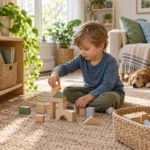
Two toy guests are coming to a picnic, and the menu has not been decided. That is enough of a beginning. A small pretend picnic can happen on an appropriate clear patch of floor or at a low table, using suitable play materials already at home. You can join as a guest, help with the first invitation or simply make room for the scene. The picnic may become a café, a birthday or a journey somewhere unexpected. Let your child decide how far the story wants to travel.
Give the guests a place to sit
Choose a space that works for the household and will be easy to clear afterwards. A small cloth can mark the picnic area if it is suitable for the setup, or you can simply name a clear spot. Bring out one or two familiar toy guests rather than the entire collection. Ask where they would like to sit and let that first choice belong to your child. The scene does not need matching dishes or a special basket to feel like a place where something is happening.
Use the food you already pretend with
If you have appropriate play food, offer a small selection. If not, the meal can be imaginary: a plate with an invisible sandwich may be quite enough for the story. Avoid substituting unsuitable small household objects just to make the table look full. Keep actual food and pretend materials clearly separate and use everything according to its intended purpose. The interesting part is choosing what to serve and who receives it, rather than creating a realistic menu with every ingredient represented.
Offer one line, then listen
You might speak for a toy guest: ‘I have come a long way and would love a little lunch.’ Leave space for your child to answer or change the situation. The guest may receive soup, be told to wait or become the cook instead. Follow that response rather than supplying a whole sequence of events. A few ordinary exchanges can give the play momentum. Silence is useful too; your child may be busy arranging something that makes perfect sense within their own story.
Keep practical jobs inside the play
A toy can help carry a plate, ask where a cup belongs or gather dishes when the picnic is over. Those small jobs give you natural ways to participate without directing every action. If another child joins, offer a simple role or separate materials where appropriate, then let the players negotiate with adult help as needed. Avoid assuming the scene will teach sharing automatically. It is a pretend activity with real people taking part, and those people may want different things from the moment.
Make changes that follow an existing idea
If your child mentions rain, you could wonder where the toys might take shelter in the pretend scene. If someone has a birthday, an imaginary cake might appear. Add one possibility at a time instead of expanding the picnic into a large production. You can also keep it exactly as it began. Repeating a familiar serving action may be the enjoyable part. The adult does not have to provide constant novelty for the scene to remain worthwhile.
Let the guests help say goodbye
When the space is needed, give a little notice and offer a final serving or farewell. The guests can return to their usual places while the dishes and food go back together. Your child might want to leave one small detail ready for later, if the room can accommodate it. Otherwise, the picnic can be finished for today. A simple shared story does not need a photo, a craft or a new purchase to become a pleasant part of the afternoon.