The short version
A little help with your decision
Worth considering for open-ended building, especially if your child likes starting again with a new idea. The larger collection gives you options, but you do not need to offer every piece at once. Make sure you have a comfortable place to play and a realistic tidy-up plan.
A good fit if…
Your child meets the stated age guidance and enjoys joining pieces, taking them apart or deciding what to make next. You can keep a small building area clear for a little while.
Look elsewhere if…
You want one fixed puzzle, already have a suitable building set, or need an activity with very few loose pieces to gather.
A tower does not have to become a castle. Sometimes the fun is a short wall, a wobbly stack or taking everything apart before it has a name. If that sounds like your child, an open-ended block collection may fit better than a toy with one task to complete.
The set this review is about
This is the blue MEGA BLOKS First Builders Big Building Bag whose Amazon detail page described sixty blocks in ten shapes and nine colours, with age guidance of one year and up, when checked on 14 October 2026. The listing also describes storage. Check the exact colour, piece count and age label before buying, because a familiar product name can cover more than one variant.
Start smaller than the bag
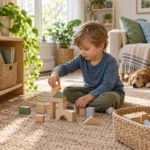
You can begin with a handful of pieces on a clear patch of floor. Try making a little line or connecting two blocks, then let your child decide whether to copy, change or ignore your idea. There is no need to build a model that looks like the picture on the packaging.
Keeping some pieces in reserve can make the activity easier to start and easier to finish. If your child wants more, bring a few over. If a small selection is enough, that is useful too. The size of the set does not need to become the size of every play session.
Think about the room you actually share
A building project may grow sideways before it grows upwards. Look for a spot where a few pieces can stay briefly without blocking a doorway or a busy route through the room. In a shared living room, a small clear patch may be more practical than a permanent building corner.
At tidy-up time, give the blocks one destination. You might gather them together while your child adds a few, or keep the job small by putting unused pieces away during play. The included bag can be helpful for storage; it cannot promise a quick clean-up every day.
What to check if you already own blocks
It is tempting to assume that two chunky-looking sets will fit together. Check compatibility with the manufacturer for the specific sets instead. Also ask whether more pieces would add something your child wants. A smaller collection already in your home may be plenty for the sort of building they enjoy.
Building or matching?
A building bag offers many possible arrangements. A shape sorting cube offers a more defined matching puzzle. Neither format needs to fill every play moment. If you are choosing one, our side-by-side guide can help you think through the space and play style before buying.
Our take for a busy family
Shortlist this set if making and remaking is the activity you want to encourage at home. We have not tested the blocks, so piece fit and durability remain questions to check through current product information and your inspection of the item. A modest first session, with room to stop and start again, is a more useful plan than expecting the whole bag to keep a child occupied on its own.
Strengths
- The building format leaves the next project up to the child.
- A smaller selection can be offered while the rest stays put away.
- The linked set includes a storage bag, so there is a clear destination at tidy-up time.
Limitations
- A collection of loose blocks can spread beyond the original play spot if you offer them all.
- A bag stores the blocks but does not remove the job of collecting them.
- We have not tested piece fit, wear or compatibility with other block systems.