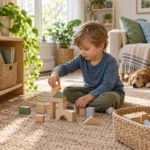
The blocks have become a village, and dinner is nearly ready. To you, the room may need clearing; to your child, the story may have only just begun. A small plan for unfinished play can help both needs have a place. It might be a tray for one building, a photograph for a larger scene or an agreement that part of the setup can stay until tomorrow. The useful question is what you can realistically preserve without making the shared room difficult to use.
Ask which part matters most
Before moving everything, pause to find out what your child wants to return to. The answer may be one tiny detail rather than the whole arrangement: a doorway, a character waiting in a particular place or a pattern they worked hard to make. You can say, ‘Show me the part you want to keep.’ That gives you a clearer starting point for a compromise. If there is no time for a long discussion, offer one simple choice between two options you can actually manage.
Choose a boundary that works in your room
Decide where unfinished play can safely wait, taking account of walkways, other household members and the materials involved. A clear shelf or a suitable tray may work for a small creation. A larger scene might have to be reduced to one section. Explain the available space in ordinary terms: ‘This part can stay on the tray; we need the rest of the floor clear.’ A visible limit can be easier to understand than an indefinite promise that everything will remain exactly as it is.
Move only what can sensibly be moved
Some creations travel easily and others fall apart when lifted. Invite your child to help decide how to move a suitable piece, while an adult handles anything awkward. Follow the care and storage instructions for the materials. Wet artwork, modelling materials and loose construction pieces have different needs. If moving the creation would spoil it or create a problem, choose another way to remember it. The aim is a manageable continuation, not preserving every object at any cost.
Use a picture when the scene needs to come down
A quick photo can record a larger arrangement before it is packed away, if that feels useful to your child. You might also draw a simple map or write a sentence about what was happening. Keep the record for your family in a way you are comfortable with; it does not need to become a social post. A picture will not feel equivalent to keeping the scene for every child, so acknowledge that disappointment rather than presenting it as a perfect replacement.
Agree on when to look again
Choose a realistic next opportunity to return to the saved part. ‘After breakfast tomorrow’ is clearer than ‘sometime soon’, but only offer it if it fits your routine. If the plan changes, explain what is happening and decide together what can remain. You may need a simple time limit for the resting place so it does not fill with forgotten projects. Apply that limit gently, giving your child a chance to choose what to keep, change or dismantle.
Let finishing have more than one meaning
Returning to a creation may lead to more building, a completely new story or a decision to take it apart. All three can be a useful ending. You do not need to produce a permanent object to show that the effort mattered. Notice something specific your child made or tried, then help the materials become available for another day. A small place for unfinished play can support continuity while keeping your home a shared space with room for the next ordinary task.